
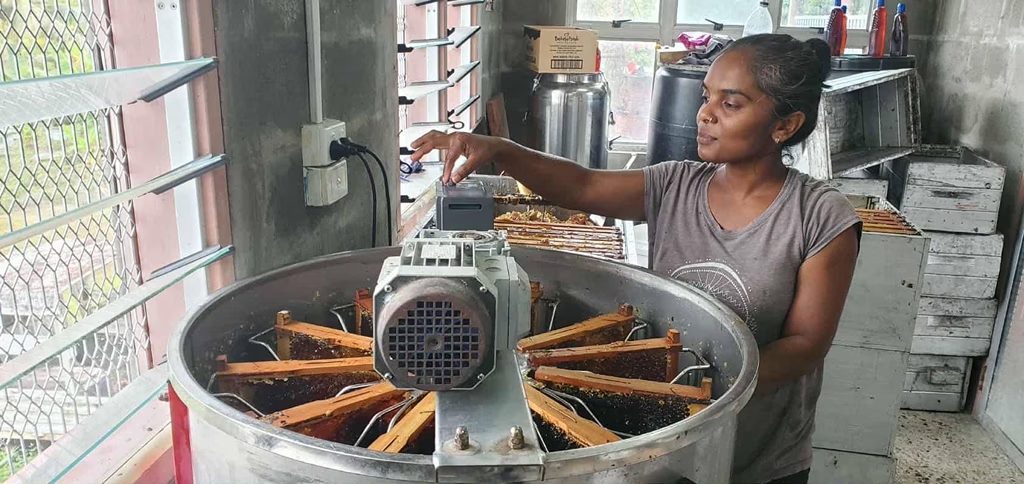
Honey is a pure product that bees make from nectar, a juice that they find in flowers. Honey consists of 82% sugar and 18% water, and contains minerals, vitamins and amino acids.
Differences in honey in terms of taste and colour
Different plants make different kinds of nectar, causing differences in honey in terms of taste and colour. Honey also darkens with age.
One bee will drink nectar from a flower and pass it on to another bee, which passes it on to another bee, and so on. As the nectar is passed from bee to bee, it mixes with enzymes that convert the nectar into honey. Finally the nectar is packed into the cells of the comb, and the bees will then fan it with their wings until the moisture content drops below 18%. At this point, the conversion from nectar to honey is completed and the honey is sealed with wax capping. Honey that has a moisture content of 18% or less will not ferment and can last indefinitely.
Honey comes in a multitude of flavours, colours and smells. Much of its character is determined by the plants in bloom from which the bees get their nectar, but age can affect honey as well. The older the honey is, the darker it gets.
When to harvest
Once a hive is full of honey, it must be harvested or else the bees will slow honey production because there is nowhere to store it. If you cannot harvest the hive when it is full, add a third box to create new space. Check the hives every two weeks or so to monitor this space. It is important that the harvester does not extract honey from frames that have not been sealed as this will not be proper honey and will spoil before long.
It is best to harvest honey early on a sunny morning as the bees will be quieter.
Specialized equipment
Extraction is normally carried out in a room which has screened windows. The room should be hygienically clean.
Honey extraction requires quite a bit of specialized equipment. This might be expensive for you when you first start out. You can borrow or hire equipment, or join together with other beekeepers and purchase it as a group and share the costs.
Your basic equipment for extraction is:
- An extractor: A machine with a stainless steel drum in which there are a number of baskets in which the uncapped frames are placed. These baskets spin when the hand crank is rotated causing the honey to fly out of the cells. There is a honey gate at the bottom which can be opened to drain the tank of its contents when required.
- Harvesting boxes: These are similar in size to Nucleus boxes, but they don’t have an entrance. They are used to collect frames full of honey from the hives. Because they can only carry 5 frames each, they are less heavy to carry.
- A number of empty hive boxes to put frames into after they have been spun
- An uncapping knife: a special knife often with a serrated edge used to remove the cappings from comb
- A set of strainers (nylon and stainless steel)
- 20 Litre drums with lids and fitted with honey gates
- An uncapping tank/basin/tray and rack
- The fames to be uncapped are placed on the rack over a collection tray. Here the cappings are cut off, and much honey drips through the rack and is collected into the tray.
- A clean bucket with a lid to put the wax cappings into
Your equipment should be maintained in a very clean state to ensure you provide a quality product to your consumers.
Before harvesting, the extraction room and all the equipment should be thoroughly cleaned and laid out to ensure the most efficient harvest.
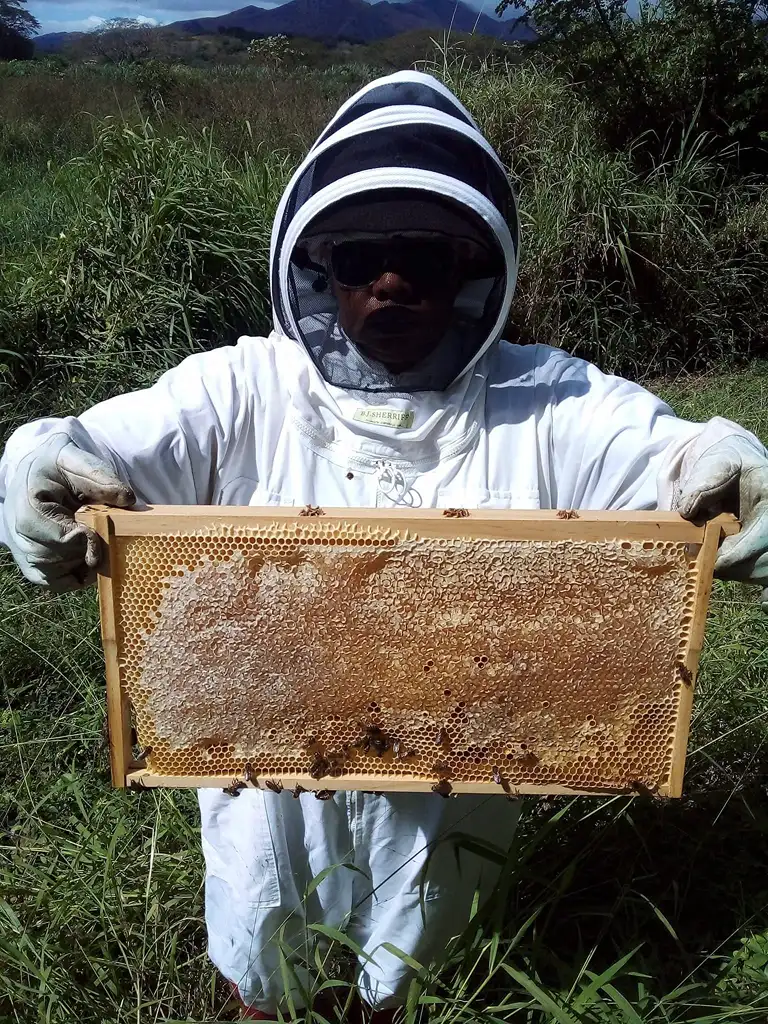
Remove only those frames with completely sealed honey
Remove only those frames with completely sealed honey
Never harvest frames that have unsealed honey, or. Do not harvest honey whilst you are feeding the colony with sugar or sugar syrup.
During harvesting, a beekeeper will visit the hives and remove only those frames with completely sealed honey. If he removes unsealed nectar and this mixes with honey, it will ferment and have a very poor shelf life.
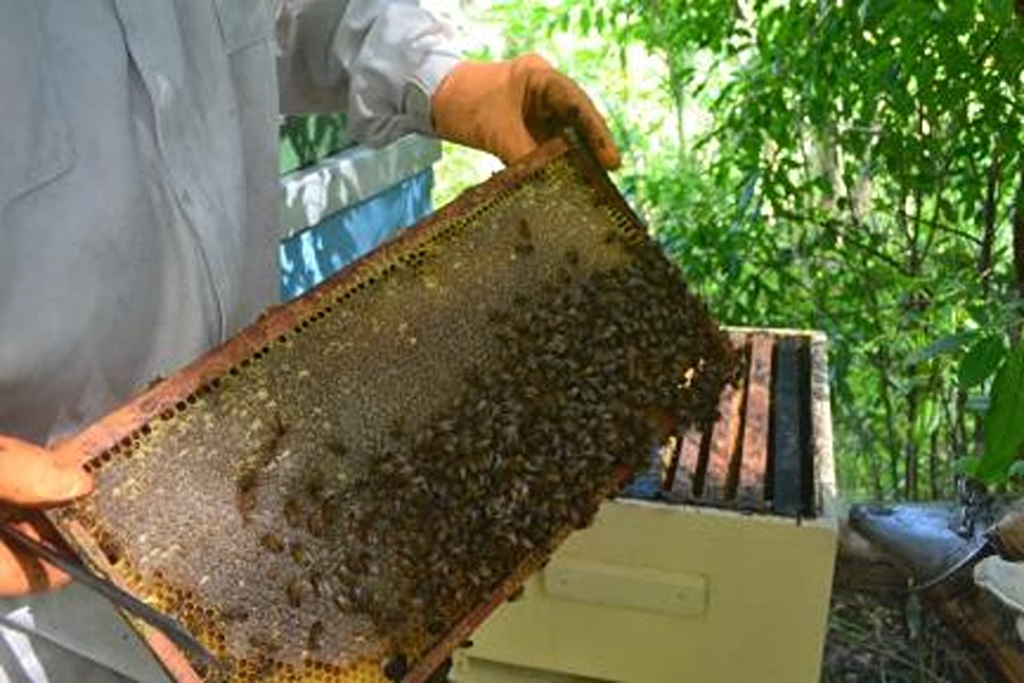
Full frame of capped honey. This is suitable for extraction.
He will also not harvest frames that contain brood. He will brush off the bees with a soft clean brush back into their hive and place these frames into the harvesting box and put the lid on. He will then carry these boxes to the extraction room.
Note that frames of sealed honey are heavy (2-4kg each) and so it is an advantage if the extraction room is not very far from the hives.
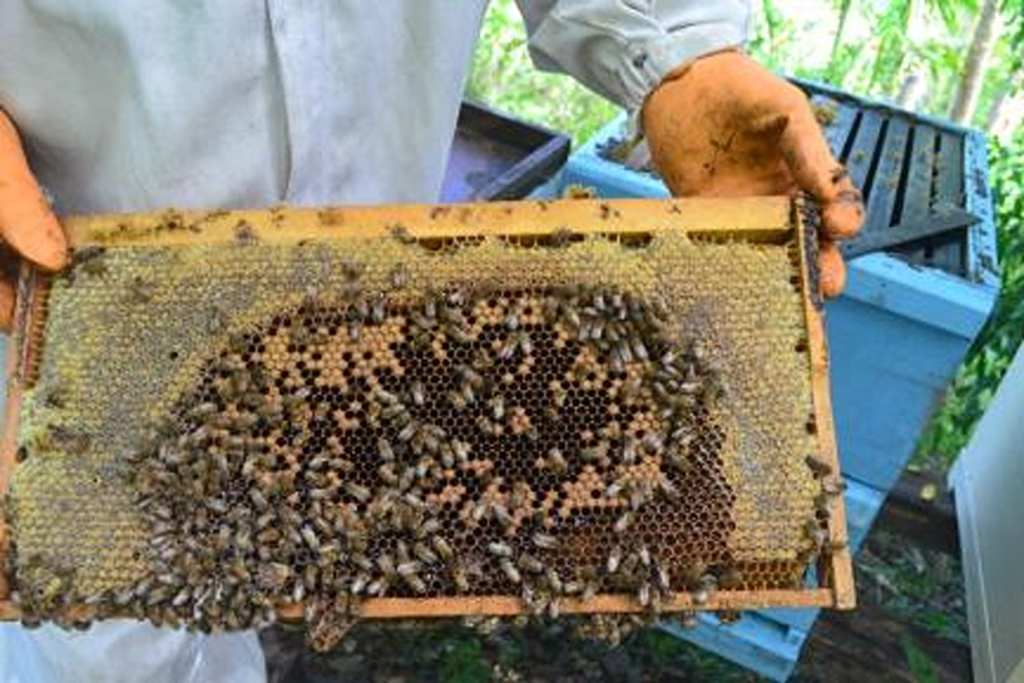
Frame with capped honey and brood – not suitable for extraction
Note that the beekeeper should not harvest every last drop of honey from a hive. Some should be left for the bees themselves, especially toward the end of the honey flow.
Many beekeepers do not harvest honey from the bottom box.
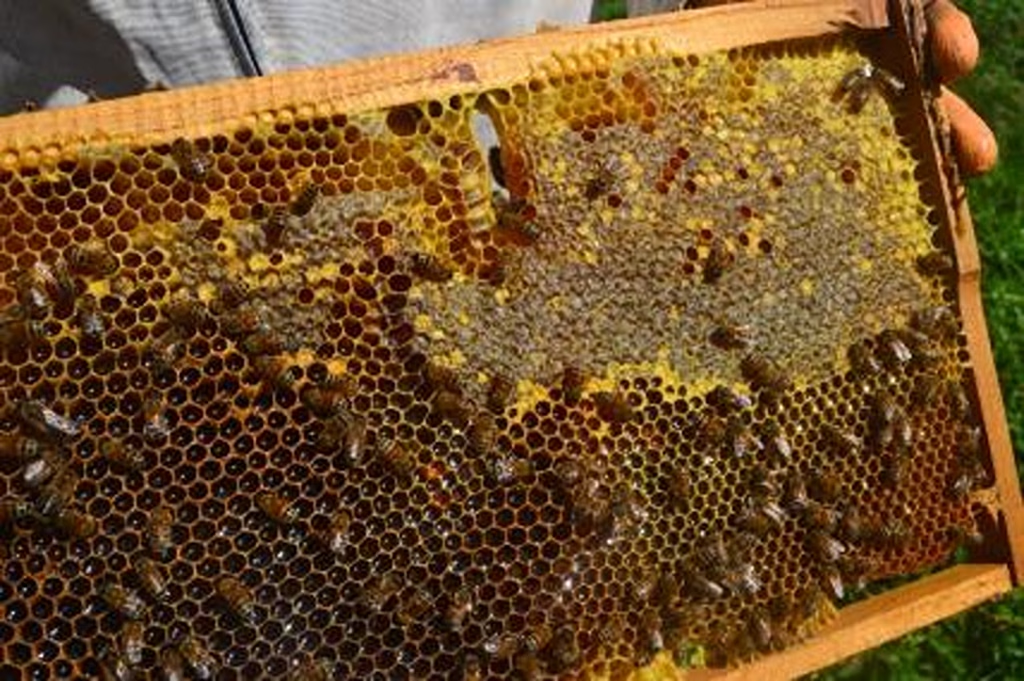
Frame with unsealed nectar and capped honey – not suitable for extraction
Seal the extraction room
In the extraction room, the doors and windows are kept shut to prevent bees entering to rob the honey. If lots of bees enter the room, they will get stuck in the loose honey and potentially lower its quality.
The wax cappings on the honey frames are cut off with the uncapping knife so that the honey can come out. A sawing movement is used similar to cutting a slice of bread. Be careful not to penetrate too deep.
The frames are then placed in an extractor such that the tabs on the frames trail behind when the frames are spun.
This is because the cells of the comb are slightly angled upwards to prevent the nectar spilling out. If the frames are placed into the extractor incorrectly, the centrifugal force will not completely empty the honey out of the frames.
Noting that frames have 2 sides, the frames must be turned over after spinning in one direction to enable the other half of the frame to be emptied in a second spin.
It is important not to spin the wooden frames too vigorously or else the wax comb can tear off the supporting wires. Spin the frames for about 2 minutes each side.
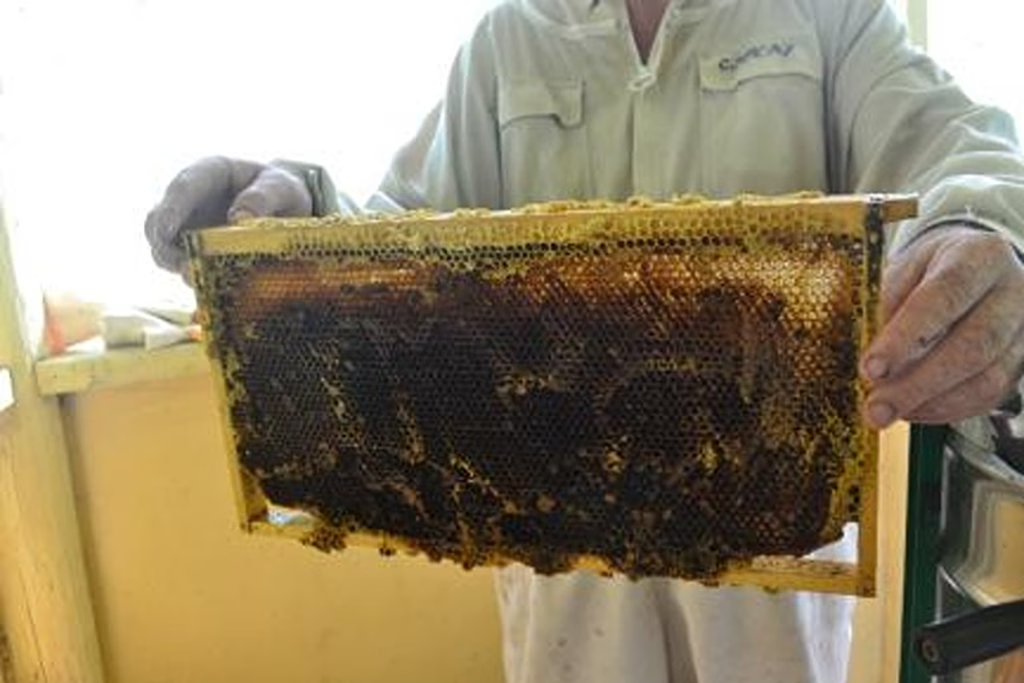
Empty frame after extraction
Sieve and clean the honey
Periodically, the honey is decanted from the extractor into a clean 20L drum.
It moves through a series of nylon or stainless steel sieves of different sizes from coarse to very fine, so that pieces of wax and other particles are removed.
Then the honey is stored in that container for a couple of days, allowing any froth and scum to settle out to the top where is can be skimmed off.
Ready for bottle!
After that, the honey can be bottled or sold in bulk.
A honey gate in the drum will help decant the honey through a funnel into the bottles.
Be sure to stop decanting once the top of the honey in the drum gets down to the level of the honey gate as scum on the surface will pass through the gate and into the bottles.
Note that honey should only be stored in food grade plastic containers or containers made of stainless steel or glass.
Honey should not come into contact with aluminium or galvanized steel as it is acidic.
In terms of quality, a beekeeper must never extract honey from a hive that he/she has recently been feeding with sugar syrup. Stop feeding syrup at least 2 months before harvesting honey.
This is a section from the excellent book:
An Introductory Guide to Beekeeping in the South Pacific
First Edition – Published 1st August 2017
By: Chuck McCay and Emily Strobaugh
- An Introductory Guide to Beekeeping in the South Pacific By Chuck McCay and Emily Strobaugh 1st Edition- DOWNLOAD
- PART 1 – Chuck’s Own Story – Beekeeping in the South Pacific
- PART 2 – Getting Started – Beekeeping in the South Pacific
- PART 3 – Equipment – Beekeeping in the South Pacific
- PART 4a – Apiary Management – How to Move a Hive – Beekeeping in the South Pacific
- PART 4b – Apiary Management – Choosing a Good Location – Beekeeping in the South Pacific
- PART 5a – Identifying Bees – The Fijian Bee – Beekeeping in the South Pacific
- PART 5b – Identifying Bees – Identifying the Three Castes – Beekeeping in the South Pacific
- PART 6a – The Bee Hive – The Annual Hive Cycle – Beekeeping in the South Pacific
- PART 6b – The Bee Hive – Supplemental Feeding – Beekeeping in the South Pacific
- PART 7b – Hive Inspection – How the Hive is Arranged and How the Queen Lays Brood – Beekeeping in the South Pacific
- PART 7a – Hive Inspection – How to Open a Hive and Work Safely – Beekeeping in the South Pacific
- PART 7d – Hive Inspection – What You Will See in a Hive – Beekeeping in the South Pacific
- PART 7e – Hive Inspection – Keeping Hive Records – Beekeeping in the South Pacific
- Part 8a – Identifying Pests – Wax Moth – Beekeeping in the South Pacific
- Part 8b – Identifying Pests – American Foulbrood AFB – Beekeeping in the South Pacific
- PART 9 – Managing Space in the Hive – Beekeeping in the South Pacific
- PART 10 – Weak Hives – Beekeeping in the South Pacific
- PART 11a – Swarming and Splitting – Swarming – Beekeeping in the South Pacific
- PART 11b – Swarming and Splitting – How to Split a Hive – Beekeeping in the South Pacific
- PART 11c – Swarming and Splitting – RAPID SPLIT – 5 frame Nucleus box, 60-70% success – Beekeeping in the South Pacific
- PART 11D – Swarming and Splitting – 30 MINUTE WALK-AWAY SPLIt – Beekeeping in the South Pacific
- PART 12a – Honey – Harvesting Honey – Beekeeping in the South Pacific
- PART 12b – Honey – Handling Used Wax After Harvesting – Beekeeping in the South Pacific
- PART 12c – Honey – Selling Your Honey – Beekeeping in the South Pacific