
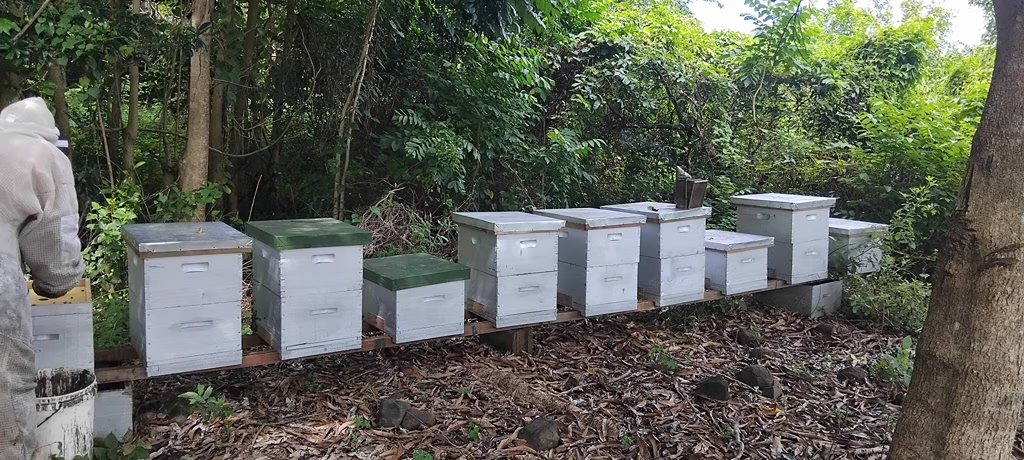
Choosing a good site is less critical than you might think, but an important feature is that it should be easily accessible. Remembering that honey is heavy, you don’t want to have to walk a long way to harvest it.
Security
Having your hives close to home is a good idea. For security, the best apiary sites are where access to the site is limited by the farm owner. This reduces the potential that someone might steal your honey, your brood or even your entire hives.
Land Aspect
The site is much easier to maintain if it is on level ground. Apiaries on slopes are more difficult to work.
Keep your apiary clean: weed it and cut the tall grass and remove any obstacles likely to cause you to trip. Cut a firebreak (6m wide path cleared of all burnable grass sticks) around your apiary.
It is important to think about where the bees will be foraging for nectar to make honey. They can travel over four km from their hive to search for food, so the flowers you grow at home will not be their only source of nectar. The taste of the honey will depend on the nectar source. Forests including mangroves contain a lot of flowering plants and are generally good for honey production, whereas a field of burnt, cut sugarcane will produce a lot of dark honey that tastes a bit like molasses and is generally considered a poorer quality.
Find out if there are other beekeepers in your area (for your local Association see Appendix V) because your bees may have to compete with them for nectar and pollen.
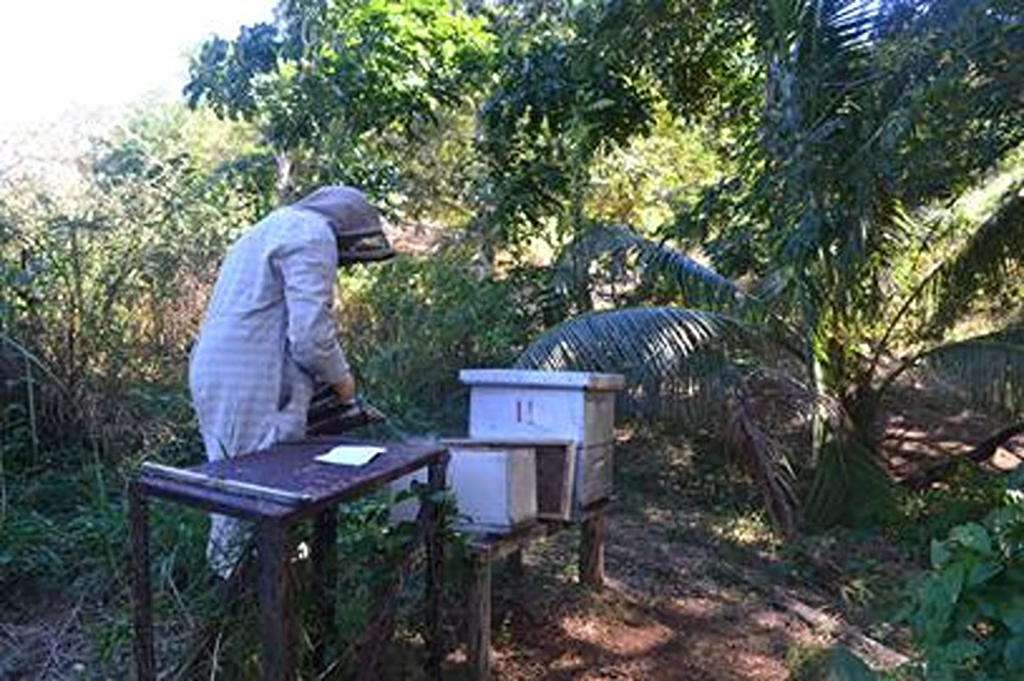
A poor apiary location because it is on a steep slope, is too shaded and overgrown with weeds.
Some areas have a history of disease such as American Foul Brood. Try to avoid areas where there has been a history of disease outbreaks. Refer to the Ministry of Agriculture and Biosecurity for information on this in Appendix V.
Bear in mind extreme weather events such as cyclones. It can be helpful to have your hives in a sheltered spot or even plant a wind break.
Avoid areas where flooding is likely to occur and areas subject to the full brunt of cyclonic winds. Bees prefer sunny positions or partial shade. Too much shade, such as in a forest, tends to make them more aggressive; this also causes the boxes to moisten, rot, and develop diseases.
Facing the opening of the hive towards the rising sun can also encourage the bees to get to work sooner.
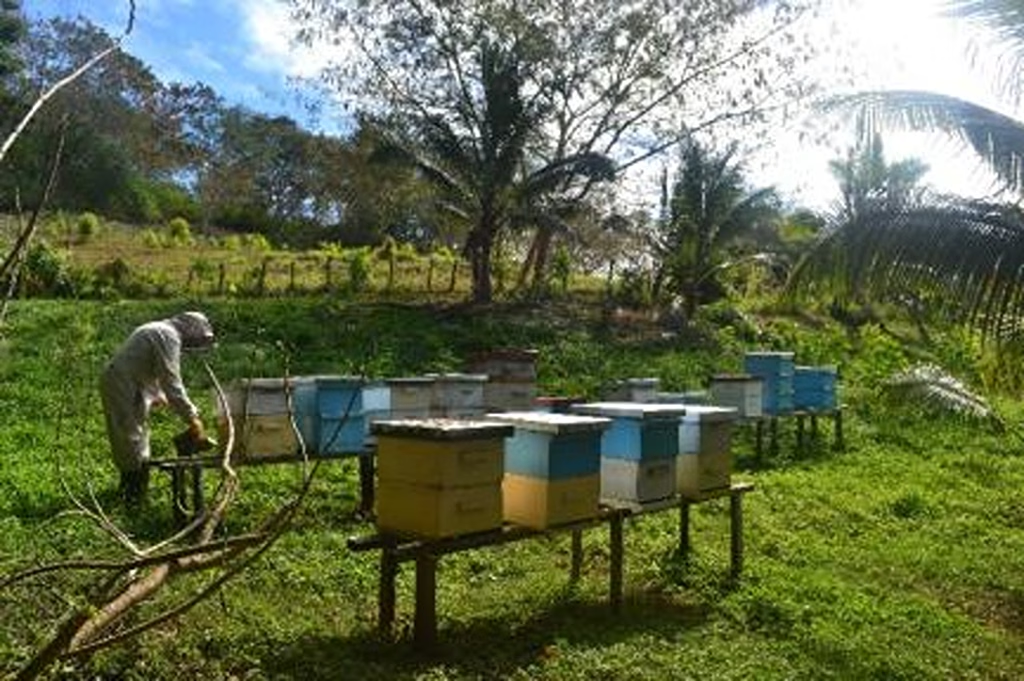
A good apiary location, because it’s fairly level, well mown and in full sun.
It is also a good idea not to face the hive toward a house (bees are attracted to lights at night) or oncoming wind, this is to keep the hive warm. It can be dangerous (and illegal) to keep bees in town suburbs. Outside of town, if you live in a community where houses are still clustered somewhat closely together, it is polite to tell your neighbours of your intention to keep bees and ask them for their approval. A bottle of honey given to your neighbour now and then will “sweeten the deal.”
If your apiary is on a farm, it’s best to keep your hives away from livestock. If the animals are tied with ropes, the hive can topple as well as harm the animals.
No land?
It’s even possible for beekeepers to be landless and still keep hives through a gentleman’s agreement. Just find a small block your friend is not making use of and ask for permission to put some bee hives on it. Tell him that your bees will fertilize his vegetables and give him 25% extra produce, and of course share a little honey with him. Some beekeepers ‘rent’ an area on farms to keep bees, typically paying the landowner an annual fee of between $100 and $200 for use of the land.
Provide a water source for your bees
Another aspect of hive location is being able to provide a water source for your bees. Bees consume about one bucketful for 10 to 20 hives daily.
This is because they use water as well as their fanning of wings to cool down the hive on a hot day and to dilute honey for consumption. If you put a bucket of water near a hive, you may cause a number to drown. Instead, put water in a shallow container with stones in it for the bees to sit on. Alternatively you can let some leaves float in a bucket.
This is a section from the excellent book:
An Introductory Guide to Beekeeping in the South Pacific
First Edition – Published 1st August 2017
By: Chuck McCay and Emily Strobaugh